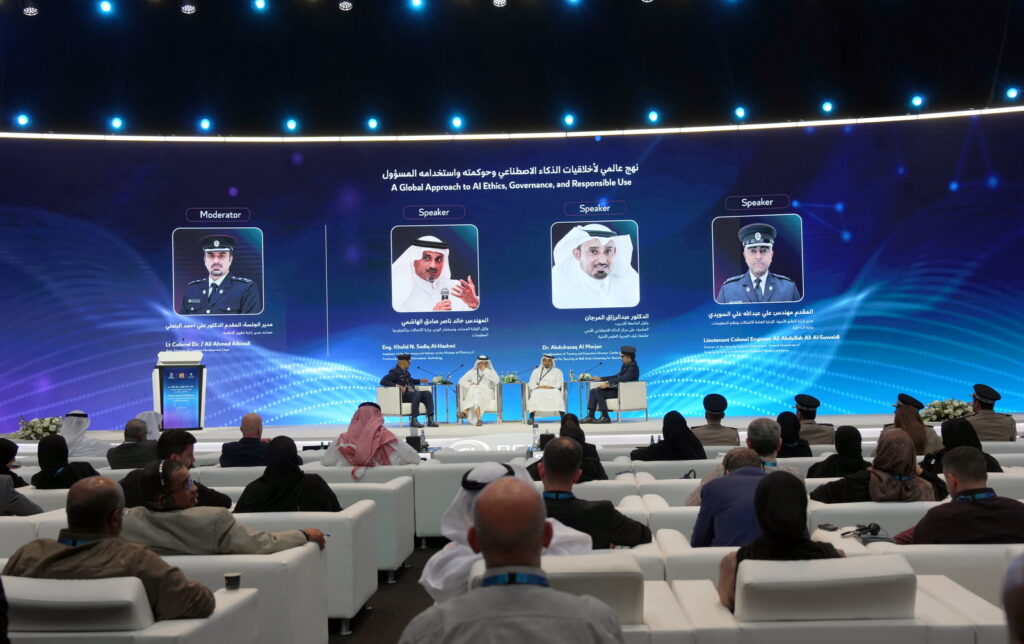
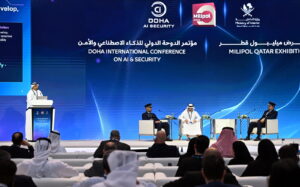
21 October 2026 – Doha, Qatar: The Doha International Conference on Artificial Intelligence and Security (Doha AIS), held over three days alongside Milipol Qatar 2026, is exploring the role of artificial intelligence in enhancing homeland security, protecting data in intelligent, autonomous security systems, and combating cybercrime. Bringing together leading experts and specialists, the conference is also addressing the legal and ethical frameworks governing these technologies.
The first session, titled “A Global Approach to AI Ethics, Governance and Responsible Use,” featured Eng. Khalid Nasser Al-Hashmi, Assistant Undersecretary and Advisor to the Minister at the Ministry of Communications and Information Technology (MCIT); Lieutenant Colonel Engineer Ali Abdullah Al-Suwaidi, Director of the Security Systems Department at the General Directorate of Communications and Information Systems, Ministry of Interior; and Dr. Abdulrazaq Al-Morjan, Vice President for Training and Supervisor of the Center of Artificial Intelligence for Security at Naif Arab University for Security Sciences. The session was moderated by Lieutenant Colonel Dr. Ali Ahmed Al-Binali, Assistant Director of the Systems Development Department at the General Directorate of Communications and Information Systems.
In his presentation, Eng. Khalid Nasser Al-Hashmi outlined MCIT’s role in regulating AI and its applications, as well as the relevant laws and regulatory frameworks. He highlighted the importance of public-private collaboration in developing AI systems, while addressing international concerns about their use. He also stressed the need for clear standards governing data and information use to ensure security, build trust, promote transparency, and uphold ethical principles.
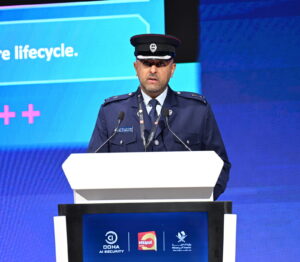
Lieutenant Colonel Engineer Ali Abdullah Al-Suwaidi presented a paper titled “Artificial Intelligence in Law Enforcement,” highlighting the Ministry of Interior’s experience in the responsible use of AI. He outlined key principles for sustainably deploying intelligent systems to enhance security, improve operational efficiency and public services, accelerate response times, and support decision-making, while safeguarding privacy, fairness, and cybersecurity. He explained that the Ministry’s approach is guided by the Qatar National Vision 2030, the National Artificial Intelligence Strategy, and the Digital Agenda 2030, with an emphasis on developing national capabilities, strengthening data infrastructure, and ensuring that technology is used in accordance with ethical principles and societal values.
During his address, he noted that the Ministry of Interior operates within an AI governance framework built on six core principles: legal compliance, privacy protection, fairness, transparency, accountability, and human oversight. Humans retain authority over decisions with significant consequences, while AI systems serve a supporting role through analysis and recommendations. He also reviewed key milestones in the Ministry’s digital transformation, from the introduction of e-gates at Hamad International Airport and the smart security solutions deployed during the FIFA World Cup Qatar 2022 to automated traffic enforcement systems.
Concluding his presentation, he emphasized that the future of AI in the security sector depends not only on technological advancement but also on institutions’ ability to establish an integrated framework of policies, standards, accountability, and oversight. He identified responsible innovation, enabling legislation, data protection and privacy, accountability, human oversight, international cooperation, and continuous improvement as essential factors for success.
For his part, Dr. Abdulrazaq Al-Morjan underscored the importance of building national capabilities and strengthening AI sovereignty. He stressed the need to retain control over AI-generated outputs and verify them, rather than simply relying on information produced by intelligent systems. He also addressed the importance of human expertise, safeguarding sensitive data, and ensuring that AI systems and their applications comply with legal and humanitarian requirements. Dr. Al-Morjan further highlighted the role of specialized security education institutions in developing practical AI solutions and transferring them to relevant authorities. He noted that universities should serve as strategic partners whose contributions extend beyond education to delivering practical solutions that support AI applications in the security sector. He concluded by calling for the establishment of a joint Arab framework bringing together security agencies and technology partners to develop intelligent solutions tailored to the specific needs of Arab countries.
Milipol Qatar 2026 continues until tomorrow, Thursday 22 October, at the Doha Exhibition and Convention Center (DECC), with more than 270 exhibitors from 33 countries showcasing the latest homeland security technologies and solutions, alongside the final day of the Doha International Conference on Artificial Intelligence and Security.
Doha International Conference on AI and Security Discusses Responsible AI Use in Homeland Security