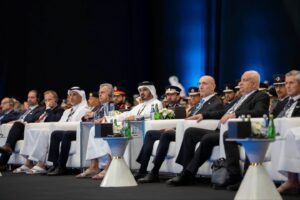
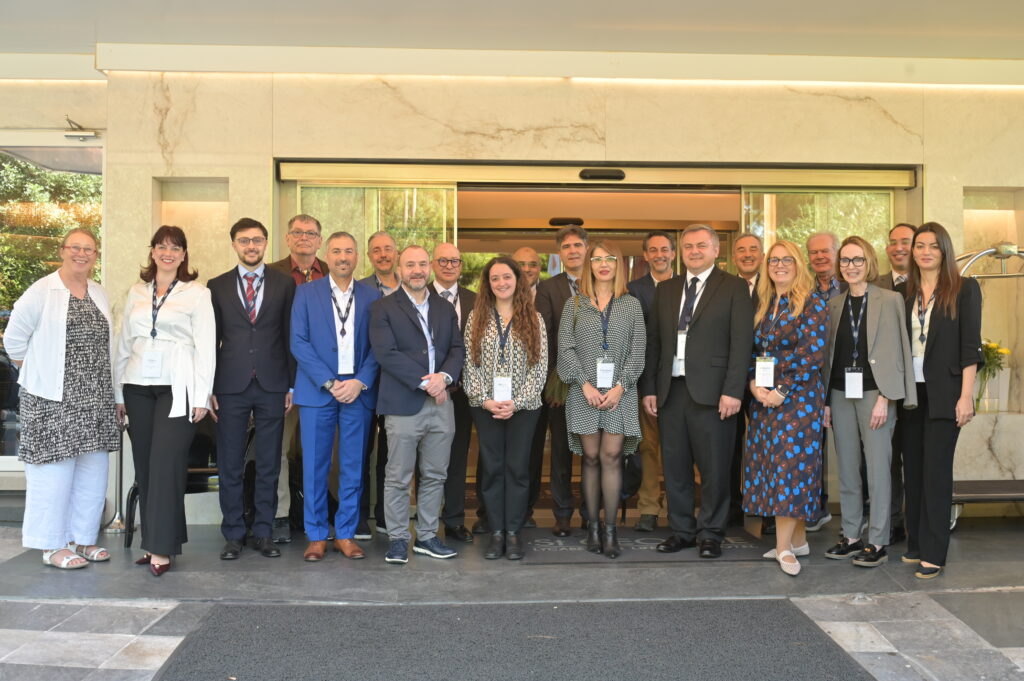
Georgetown University in Qatar (GU-Q) convened a one-day workshop, Energy and Maritime Security in the Contemporary Mediterranean and Beyond, on Oct. 9, 2026 at the Saint George Lycabettus in Athens, bringing together leading scholars, policymakers and industry experts from across the Mediterranean, the Gulf, Europe and the United States.
Held against a backdrop of offshore gas discoveries, an accelerating energy transition and renewed great-power competition in the region’s waters, the workshop examined energy and maritime security as a single, and increasingly interconnected challenge. The program was opened by Dr. Clyde Wilcox, Acting Dean of GU-Q, and organized by the university’s Energy Studies Program.
Discussions were structured around four panels: the contested reordering of the Eastern Mediterranean; the agency of small maritime powers and lessons for the East Mediterranean; the supply chains and critical infrastructure underpinning the energy transition; and the human capital, education and skills required to sustain it. Speakers were drawn from institutions including Qatar University, the Stockholm International Peace Research Institute (SIPRI), King’s College London, the University of East London, Texas A&M University at Qatar, the MIT Center for Energy and Environmental Policy Research, the National Technical University of Athens, NCSR “Demokritos” and the Hellenic Electricity Distribution Network Operator (HEDNO), alongside senior figures from the maritime and energy industries.
“In a time of insecurity, instability and disorder, it is vital to consider how energy and maritime security are playing out in key regions like the Mediterranean and to learn the lessons of other regions on these matters.” said Professor Rory Miller, Director of the Energy Studies Program and the Small States Research Program at GU-Q.
“The Mediterranean has become a place where energy, security and sustainability can no longer be treated as separate questions,” said Dr. Valentini Pappa, Program Director of New Academic Initiatives at GU-Q and the workshop’s organizer. “By bringing scholars, policymakers and industry leaders to the same table, we wanted to examine these challenges as the single, interconnected story they have become — and to keep the human dimension, the people and skills behind the transition, at the centre of the conversation.”
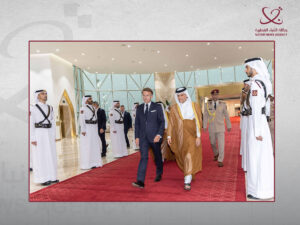
The workshop was attended by a distinguished group of guests, including the First Secretary Alanoud Ahmad Al Mohammadi of the State of Qatar to the Hellenic Republic, Ret. Adm. Stelios Fenekos, President of the Alexander Papanastasiou Scientific Institute, and senior representatives of the Hellenic Foundation for European and Foreign Policy (ELIAMEP), the Public Power Corporation (PPC Group) and The American College of Greece.
The gathering reflects GU-Q’s growing engagement on energy, climate, and security questions of shared importance to Qatar, Greece and the wider Mediterranean, and its commitment to fostering dialogue across academic, policy and industry communities.