rki.news
“International education is not just about studying abroad. It is a vital bridge of diplomacy and human connection,” reflected Allan Goodman during his return to Qatar as a Senior Visiting Fellow at Georgetown University in Qatar.
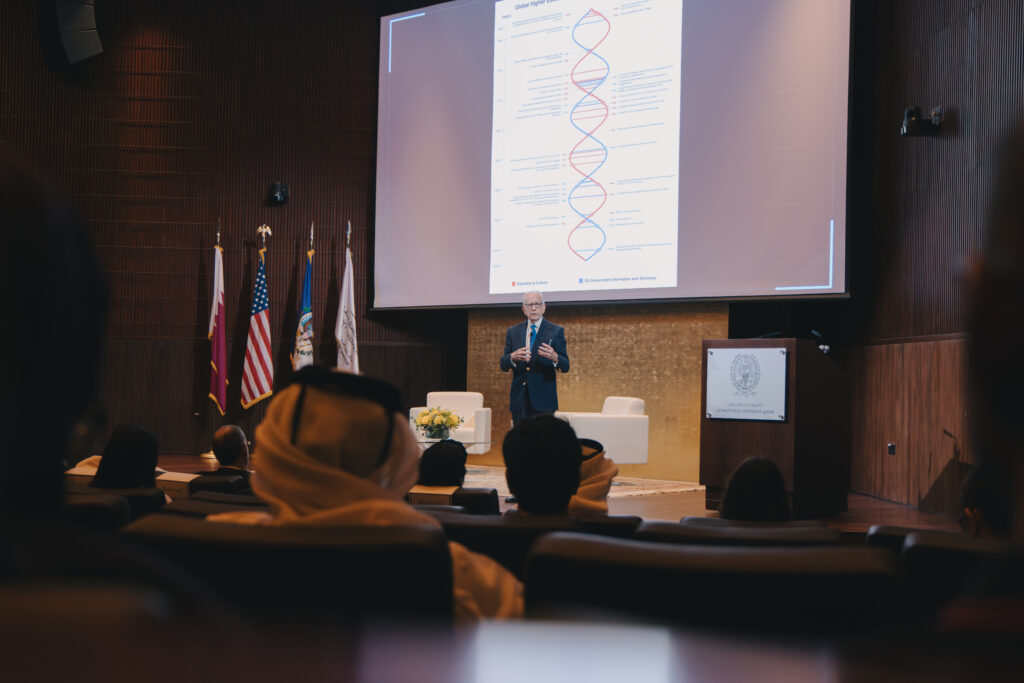
For 28 years, Goodman, the former Executive Dean of Georgetown’s School of Foreign Service, led the Institute of International Education (IIE), overseeing foundational programs such as Fulbright, advancing research on global student mobility and protecting scholars imperiled by conflict worldwide. His talk centered on his forthcoming book, “American Odyssey: Past, Present and Future of International Education and Exchange,” a milestone volume he partially wrote in Doha.
Tracing nearly four centuries of academic history, Goodman decoded the unique DNA of American higher education. Beginning in the 1630s with the founding of Harvard by early immigrants, universities began building independent global engagements long before the federal government regulated them. Over time, key historical milestones, from Yung Wing becoming the first Chinese graduate of Yale in 1854 to the establishment of the Boxer Indemnity Scholarship in 1901, the creation of the Fulbright Program in 1946 and the development of the Scholar Rescue Fund, established a powerful legacy of mutual exchange. These initiatives received funding and support through partnerships forged through international peace and reconciliation negotiations.
Reflecting on the metaphor of Homer’s “Odyssey,” Goodman described how international education has continually navigated political “monsters” and isolationist “sirens.” Yet he offered an optimistic outlook: Historical data shows that the flow of international scholars and students to America has consistently increased through world wars, the Cold War, global pandemics and changing political administrations. He attributed this resilience to “Zeus’s law of guest hospitality,” pointing to countless instances of individuals and institutions reaching out to support international students in times of need.
Among these heroes, Goodman identified more than 50 Georgetown alumni working in government on both sides of the aisle to advance international educational exchange, helping ensure that cross-border academic engagement remains resilient across generations.
Looking ahead to 2030 and beyond, Goodman highlighted Doha and Education City as living examples of modern international education. Since the early 2000s, he has worked alongside Qatari leaders to build a robust educational ecosystem through Qatar Foundation, helping launch global initiatives such as the World Innovation Summit for Education and the Education Above All Foundation.
Far from traditional study abroad programs or simple branch campuses, Goodman said Education City represents a new paradigm, offering top-tier global education in and of the world. In an era of shifting global demographics and emerging challenges, he said, “This is where international education for the 21st century is being practiced every day. And it’s bound to make the world a safer and better place for us all.”