rki.news
Doha Symposium Explores Selfhood, Human Purpose and Artificial Intelligence
Experts encourage young people to draw upon Allama Muhammad Iqbal’s philosophy of khudi to preserve human agency, intellectual independence and moral purpose in the age of artificial intelligence
DOHA: The Embassy of Pakistan in Qatar brought the philosophy of Allama Muhammad Iqbal into conversation with one of the defining questions of the modern age: how can humanity benefit from artificial intelligence without surrendering the qualities that make us truly human?
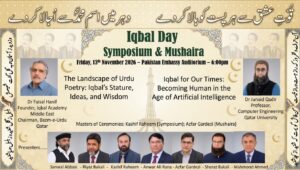
Moving beyond a conventional commemoration of Iqbal Day, the intellectual symposium, titled “Iqbal for Our Times,” invited young members of the Pakistani community to examine Iqbal not only as a great poet of the past, but also as a philosopher whose ideas can help individuals navigate the intellectual, technological and moral challenges of the present.
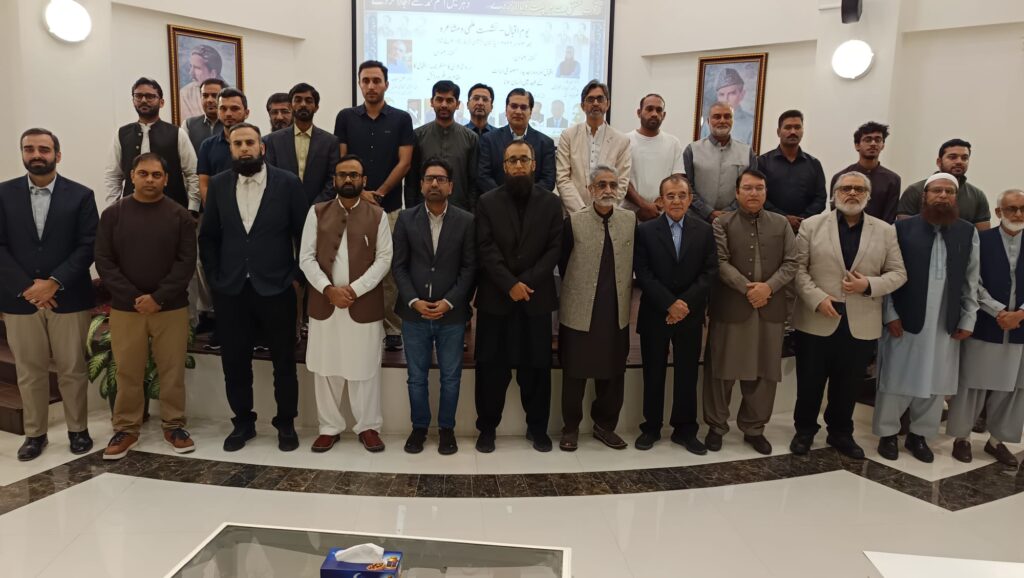
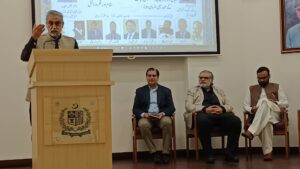
The symposium was held at the auditorium of the Embassy of Pakistan in Qatar under the auspices of Ambassador H E Muhammad Aamir. It was coordinated by Welfare Attaché Osama Idrees in collaboration with Dr Faisal Hanif, Mr Kashif Raheem and Riyaz Ahmed Bakali.
Scholars, academics, literary figures, community members and representatives of civil society attended the programme, which combined scholarly presentations, an interactive discussion with young participants and a mushaira dedicated to Iqbal’s poetry.
At the heart of the symposium was a compelling question:
How can Iqbal’s philosophy help today’s generation understand itself, respond intelligently to a rapidly changing world and contribute meaningfully to society?
From literary greatness to intellectual awakening.
Mr Kashif Raheem, President of the Pakistan Executive Forum Qatar and Executive Member of the Pakistan Welfare Forum (PWFQ), compered the first segment of the programme and Formally commenced the proceedings and invited Mr Muhammad Haroon to recite verses from the Holy Quran, followed by a naat presented by Doha-based poet Anwar Ali Rana.
The scholarly presentation, “The Landscape of Urdu Poetry: Iqbal’s Stature, Ideas, and Wisdom,” was delivered by Dr Faisal Hanif, Chairman of Bazm-e-Urdu Qatar, founder of Iqbal Academy Middle East and the Guzergah-e-Khayal literary forum.
Tracing the development of Urdu poetry from Amir Khusrow, Quli Qutub Shah and Wali Daccani to the great literary traditions of Delhi and Lucknow, Dr Faisal Hanif situated Iqbal within the wider heritage of Urdu and Persian literature.
He explained that Iqbal inherited the richness and discipline of classical poetry but transformed poetry into an instrument of philosophical reflection, intellectual awakening and social renewal. At a time when the literary accomplishments of poets such as Mirza Ghalib and Sheikh Ibrahim Zauq appeared almost impossible to surpass, Iqbal established a distinctive voice by addressing the individual conscience and speaking directly to younger generations.
According to Dr Faisal Hanif, Iqbal’s greatness lies not only in the beauty and power of his verse, but also in his ability to communicate complex philosophical ideas through language that inspires reflection and action. Drawing upon Islamic thought as well as the intellectual traditions of different civilisations, Iqbal developed a vision that responded to the spiritual, political and social challenges of his time while retaining universal relevance.
His poetry called upon individuals and communities to move beyond passivity, imitation and resignation. It encouraged them to discover their latent potential, cultivate intellectual independence and assume responsibility for shaping their own future.
An “Iqbal Test” for artificial intelligence
The symposium then turned from literary history to the technological realities of the twenty-first century.
Dr Junaid Qadir, Professor of Computer Engineering at Qatar University, presented “Iqbal for Our Times: Becoming Human in the Age of Artificial Intelligence.” He examined the relationship between Iqbal’s concept of khudi and the rapidly expanding influence of artificial intelligence on education, creativity, decision-making and human behaviour.
Drawing a comparison with Alan Turing’s imitation-based test of machine intelligence, Dr Junaid Qadir proposed what he described as an “Iqbal Test” for evaluating artificial intelligence:
Does our use of artificial intelligence strengthen human selfhood, judgement and moral agency, or does it gradually diminish them?
This question gave the symposium a distinctive contemporary focus. Rather than viewing artificial intelligence only in terms of speed, productivity or technical capability, the discussion considered its effect on human character, purpose and responsibility.
Dr Junaid Qadir explained that Iqbal’s concept of khudi should not be reduced to confidence, individualism or self-esteem. It refers to the disciplined development of a purposeful, conscious and morally responsible self through love, meaningful action, intellectual struggle and spiritual awareness.
Within this understanding, technology should serve human development rather than replace independent thought. Artificial intelligence may assist people in finding information, identifying patterns and completing tasks, but it cannot assume responsibility for a person’s moral choices, spiritual growth or purpose in life.
The discussion also highlighted Iqbal’s insistence upon a balanced relationship between reason and the heart. Reason enables people to examine and understand the world, while the heart provides the moral and spiritual orientation necessary to determine how knowledge should be used.
Connecting khudi with the Islamic principle of divine oneness, or tawhid, Dr Junaid Qadir also explored the relationship between the developed individual and the wider community, or millat. A strengthened self, in Iqbal’s philosophy, is not isolated or self-centred. It recognises its responsibilities towards society and directs its capabilities towards the collective good.
The resulting message for young people was clear: artificial intelligence should enhance human capability without weakening curiosity, creativity, judgement, responsibility or the courage to think independently.
Young participants bring philosophy into everyday life
Audience engagement, particularly the participation of younger community members, was an important feature of the symposium. Participants raised questions about personal identity, education, intellectual independence, spiritual values, technological dependence and the responsibilities of young people in a rapidly changing world.
The speakers responded by relating Iqbal’s philosophical ideas to everyday choices and experiences. This exchange moved the programme beyond formal lectures and gave it the character of an active intellectual conversation.
Young participants were encouraged not simply to admire Iqbal’s poetry, but to question, reflect and consider how its principles might influence their education, conduct and ambitions.
The discussion reinforced the idea that Iqbal should not remain confined to textbooks, annual commemorations or ceremonial recitations. His thought should inspire people to pursue knowledge, develop character, reject intellectual dependency, act with purpose and become constructive contributors to their communities.
Poetry brings Iqbal’s message to life
The scholarly discussion was complemented by a mushaira devoted to the poetry of Allama Muhammad Iqbal.
Second session was compered by Azfar Gardezi, Vice General Secretary General of Bazm-E-Urdu Qatar, an engineer and poet based in Doha.
Community members Mahmood Ahmed, Rana Anwar Ali, Sheraz Ahmed Bakali, Kashif Raheem, Azfar Gardezi and Riyaz Ahmed Bakali recited selected works reflecting the depth, beauty and inspirational power of Iqbal’s poetry.
The recitations explored themes including self-realisation, spiritual awakening, courage, national consciousness, intellectual freedom and collective responsibility. The audience’s warm response demonstrated the enduring cultural and emotional connection that Pakistanis across generations continue to share with Iqbal and the Urdu language.
Keeping technological progress aligned with human values
Addressing the gathering, Ambassador H E Muhammad Aamir reflected on the continuing relevance of Iqbal’s thought, particularly in the context of artificial intelligence and other modern technological developments.
He emphasised the importance of understanding and applying Iqbal’s philosophy so that technological progress remains aligned with human values and individuals retain their identity, judgement and sense of purpose.
The ambassador commended the organisers for creating an opportunity for meaningful intellectual and cultural engagement within the Pakistani community and acknowledged the contributions of the speakers, participating organisations, poets and community members.
The symposium reaffirmed the Pakistani community’s deep attachment to Iqbal, the Urdu language and its literary heritage. More importantly, it demonstrated how a cultural commemoration can become an opportunity for intellectual development, intergenerational dialogue and critical engagement with the challenges of the present.
Reflecting on the programme’s message for young people, Kashif Raheem President Pakistani Executive Forum Observed that the younger generation should look beyond the beauty of Iqbal’s poetry and discover the philosophical depth within it: to develop their khudi, think independently, embrace knowledge, act with purpose and contribute to building a better society.
The symposium concluded with a message that captured the spirit of the evening:
The most meaningful tribute to Iqbal is not merely to recite his poetry or remember him on commemorative occasions. It is to understand his message, internalise his philosophy and translate his vision into purposeful action.