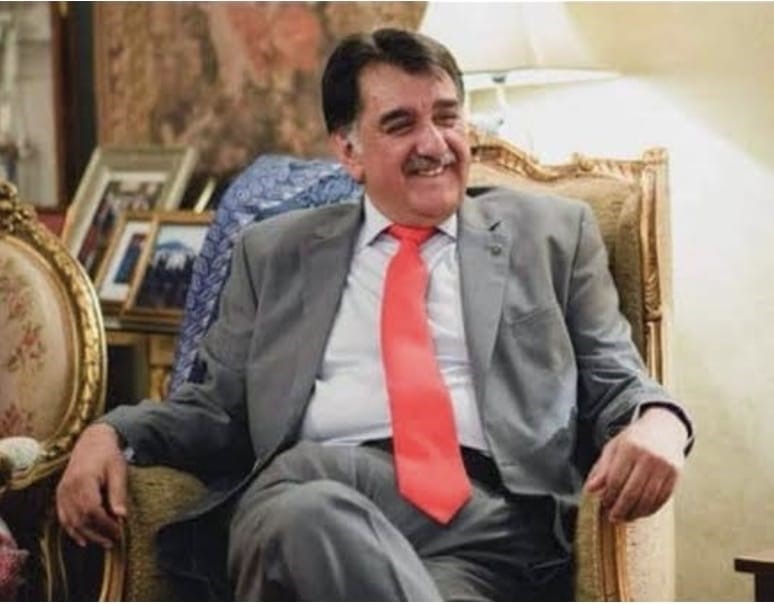
MIRPUR (AJK): Sept 16; Veteran Kashmiri leader and Chairman Turkiye based Kashmir Diaspora Coalition Dr Mubeen Shah has called for a fundamental transformation of Kashmir’s economic financing strategy, urging a shift from conventional bank lending towards productive investment, local ownership and equity financing.
In a detailed informal chat with our Special Jammu Kashmir state Correspondent Altaf Hamid Rao exclusively on the topic of “Turning Savings into Investment: Kashmir’s Economic Challenge,” , Dr Shah, also a former President of the (IIOJK) Kashmir Chamber of Commerce and Industry (2006-2009), currently living in exile in Istanbul, said the region needed a comprehensive financial ecosystem to convert local savings into productive investment.
He noted that Kashmir’s banking sector had improved considerably since his tenure at the Chamber, with the credit-deposit ratio now exceeding 60 per cent, a level advocated by the Chamber nearly two decades ago.
However, he said, the key question was no longer merely how much banks could lend, but how much productive capacity each additional rupee of credit could create.
Dr Shah called for directing credit towards sectors capable of generating employment, value addition and productive capacity, including horticulture and food processing, cold chains, handicrafts and Pashmina, tourism, renewable energy, logistics, technology, manufacturing and exports.
He also stressed the need to finance complete economic value chains rather than isolated businesses. Citing Kashmir’s apple economy, he said financing should cover inputs, procurement, grading, storage, transportation, packaging, processing and marketing to maximise economic impact.
The Kashmiri leader also advocated greater utilisation of government-backed credit-guarantee schemes to facilitate lending to small entrepreneurs lacking collateral. He said entrepreneurs needed greater financial literacy about project preparation, working capital, term finance, guarantees and export finance, while banks should actively utilise available financial instruments.
“A government scheme sitting in a file or a bank manual creates no economic activity. Utilisation is what matters,” he said.
Dr Shah further proposed developing local venture capital and equity-financing mechanisms, arguing that large-scale food processing, technology, tourism infrastructure, renewable energy, logistics and manufacturing projects could not all be financed through conventional bank debt.
To a question he suggested exploring a Kashmir-focused venture capital fund, initially supported through seed capital, matching contributions and risk-sharing mechanisms, while attracting institutional investors, business families and the Kashmiri diaspora.
Such a fund, he emphasised, should be professionally managed and insulated from political interference.
Dr Shah also proposed a longer-term pathway for successful Kashmiri enterprises to progress from bank finance to venture capital, private equity and eventually public equity through an appropriately regulated SME investment platform integrated with the wider securities framework.
He said the objective should be to enable local investors to participate in the ownership of successful enterprises rather than promote speculative activity.
He described the desired financial cycle as: savings to productive credit, enterprise growth, venture capital, equity, public investment and reinvestment.
Emphasising the importance of local ownership, Dr Shah said economic growth alone might not ensure broad-based empowerment if Kashmiris remained primarily consumers, employees and borrowers while ownership of productive assets increasingly lay elsewhere.
“The objective should be capital formation within Kashmir, not merely capital circulation through Kashmir,” he said.
He said the proposed Kashmir Credit Mission should ultimately evolve into a broader Kashmir Credit and Investment Mission, bringing together banks, RBI, NABARD, SIDBI, credit-guarantee institutions, ECGC, government departments, industry organisations, venture capital, private equity and diaspora investors.
The mission, he added, should have measurable targets, timelines and accountability and cover the entire financing pipeline from project development and bankability to credit, equity, expansion, exports and reinvestment.
Dr Shah said the ultimate measure of progress should be Kashmir’s transition from raw produce to value-added products, micro-enterprises to scalable businesses, trading to manufacturing, isolated producers to organised value chains, unemployment to entrepreneurship, and borrowers to owners.
He said Kashmir possessed substantial savings, entrepreneurial potential, natural resources, horticultural strengths, globally recognised crafts, tourism opportunities and a young population.
“The task is to connect these assets with capital at scale,” he concluded.
It may be mentioned here that Dr Mubeen Shah served as President of the Kashmir Chamber of Commerce and Industry from 2006 to 2009 and is currently Chairman of the Kashmir Diaspora Coalition and President of Kashmir House Türkiye.
Kashmir must shift from savings to investment, borrowers to owners: Dr Mubeen Shah