
rki.news
Altaf Hamid Rao
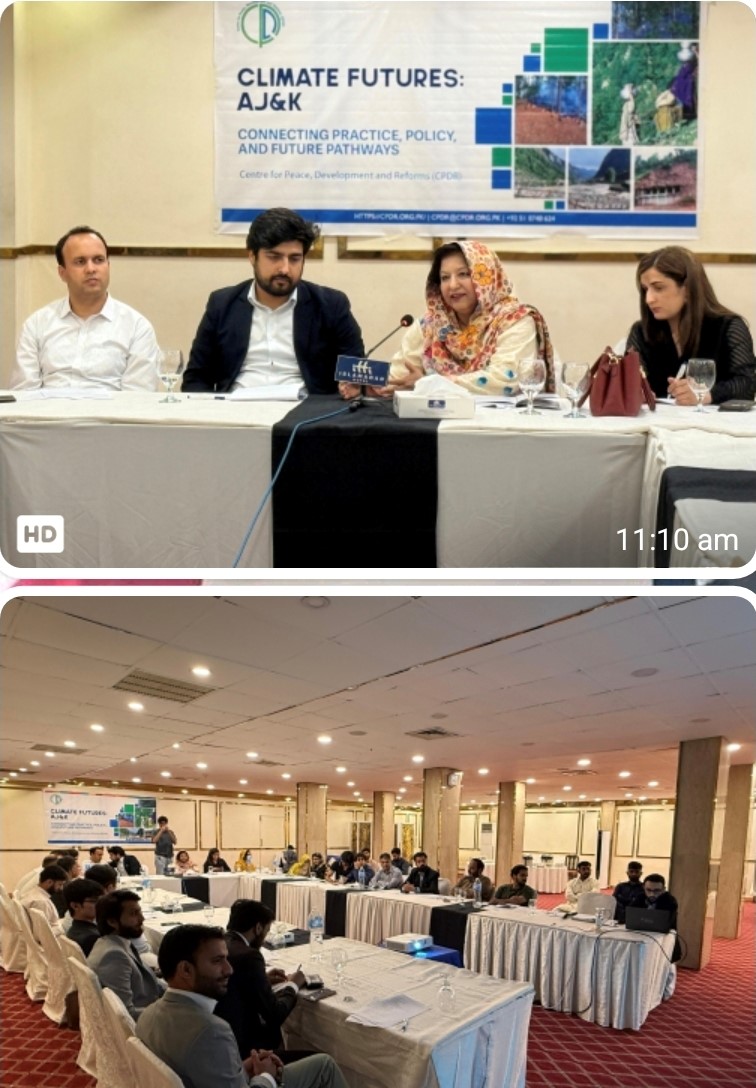
MIRPUR (AJK), May 4: The Kashmiri Centre for Peace, Development and Reforms (CPDR), a well-known AJK-based think tank, organized a “Climate Futures Session: Green Practitioners in AJK” in the federal capital, bringing together climate practitioners, civil society organisations, researchers, journalists, youth representatives, advocacy groups, and independent environmental actors working across Azad Jammu & Kashmir.
The session was held under CPDR’s broader Climate Futures Initiative, aimed at linking local climate realities, practitioner experience, and scenario-based planning to support climate resilience and evidence-based policy development in AJK.
Opening the session, CPDR Executive Director Irtaza Muhammad welcomed participants and stressed that effective climate resilience cannot be achieved through policy dialogue alone. He emphasized the importance of incorporating ground-level practitioner experience into planning, institutional coordination, and policy reform, noting that community realities must remain central to future climate strategies.
Programme Officer Huzaifa Khan introduced the Climate Futures Initiative, explaining its objective of developing future climate scenarios for AJK based on field evidence, stakeholder input, and local expertise. Participants were also invited to review draft scenarios and provide feedback through structured follow-up tools designed to strengthen participatory policy design.
The event brought together representatives from multiple organizations, including Muslim Hands, Hamza Development Foundation, Kashmir Development Foundation, BERD Foundation, Kashmir Institute of International Relations, Native Youth Club for Climate Change, Save Himalayas, Progressive Climate Foundation, AJ&K State Youth Assembly, Eco Friends Online Forum, and Climate Education Warriors, alongside environmental journalists and independent practitioners. Online participation also enabled experts, including Dr. Fahad Kazmi, to join the discussion and contribute technical perspectives.
Participants shared ongoing initiatives related to waste management, composting, recycling, plastic reuse, sustainable agriculture, water management, climate education, youth mobilisation, and community-based environmental action. Muslim Hands showcased practical models of composting and plastic recycling for eco-friendly product development, including demonstrative samples of their work.
Speakers noted that although climate initiatives are active across AJK, many face challenges such as limited funding, weak technical capacity, poor coordination, and lack of visibility. They stressed the importance of documenting local innovations and linking them with policy frameworks to improve resilience planning and long-term sustainability.
Senior journalist Jalal ud Din Mughal highlighted the role of storytelling and documentation in bringing environmental work into mainstream awareness, noting that many initiatives remain underreported due to limited media outreach and weak communication strategies.
In closing remarks, Dr. Shaheen Akhtar of the National Defence University emphasized volunteerism, commitment, and the need for a baseline climate study for AJK, calling for stronger institutional coordination and integrated planning among stakeholders.
CPDR said the session’s findings will support scenario refinement, networking among practitioners, and future climate policy recommendations for AJK, with a focus on strengthening collaboration between communities, institutions, and development partners for long-term climate resilience.

At 'Your World in Words,' we share stories from all over the world to make friends, spread good news, and help everyone understand each other better.
© 2026
Rahbar International
Leave a Reply