
rki.news
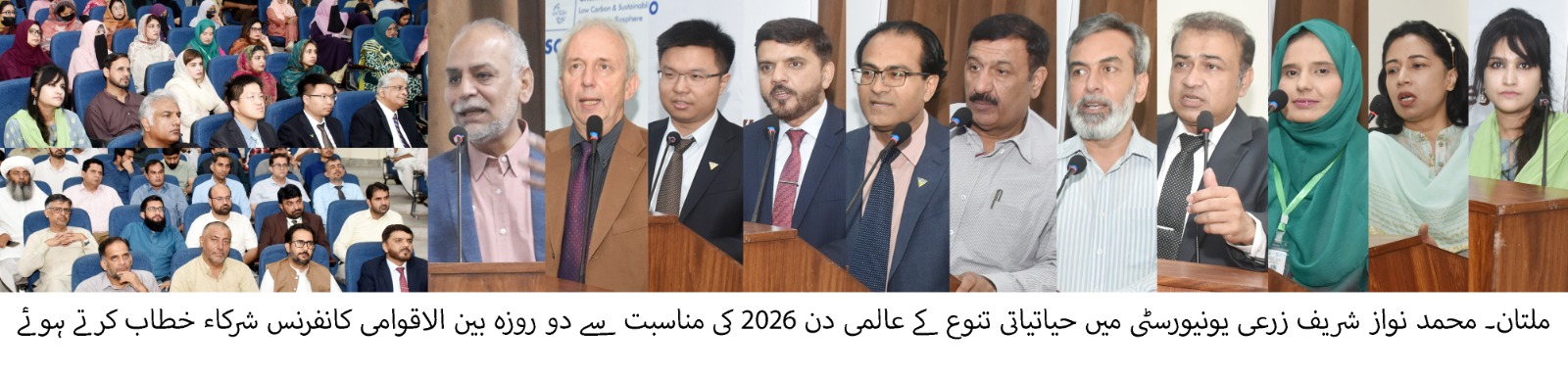
Multan: A two-day international conference marking the International Day for Biological Diversity 2026 commenced at Muhammad Nawaz Shareef University of Agriculture. The conference is jointly organized by the university in collaboration with the Punjab Agricultural Research Board, Punjab Higher Education Commission, and UNESCO Chair on Low Carbon and Sustainable Agriculture in Biosphere Reserves.
The event has brought together scientists, researchers, academicians, students, policymakers, and development experts from Pakistan and 15 countries. More than 100 research abstracts were received, covering biodiversity conservation, climate change, wildlife protection, water resources, indigenous knowledge, and low-carbon agriculture.
The inaugural session was held at the Academic Block, where Vice Chancellor Prof. Dr. Asif Ali delivered the opening address. He said biodiversity is not limited to plants and animals but forms the foundation of food systems, agriculture, soil, water, wildlife, rural economies, and human life.
He noted that arid and semi-arid regions of Pakistan, especially South Punjab, face serious challenges including water scarcity, rising temperatures, drought, soil degradation, and climate change. He stressed integrating scientific research, indigenous knowledge, institutional collaboration, and policy action to address environmental concerns.
Prof. Asif Ali said the future of agriculture depends on sustainable farming systems that ensure efficient use of land and water, reduce carbon emissions, and conserve biodiversity. He added that understanding the relationship between soil, water, plants, insects, wildlife, pollinators, and communities can improve resilience in dryland regions.
Speakers from Germany, China, the United Kingdom, and Pakistan addressed the session. Prof. Dr. Andreas Buerkert highlighted indigenous knowledge and plant diversity in Pakistan. Prof. Dr. Zhao Wenwu discussed climate change, heat stress, and plant-insect interactions. Dr. Pablo from Cardiff University spoke on genetic science in primate conservation. UNESCO Representative in Pakistan Fuad Pashayev delivered concluding remarks.
On the first day, scientific sessions covered biodiversity, wildlife, ecosystems, climate change, and resilience in arid regions. Researchers presented studies on forests, Cholistan resources, urban parks, soil microbes, pollution, birds, livestock systems, bioenergy, and climate-smart agriculture.
The second day will focus on low-carbon agriculture, women’s participation, indigenous knowledge systems, water management, and rural livelihoods. Topics include soil health, carbon reduction, Indus Basin challenges, groundwater conservation, flood-affected regions, and food systems.
A poster competition is also being held, with student research evaluated by experts. The closing ceremony will include recommendations, a future roadmap, and a book launch.
Dean Prof. Dr. Irfan Baig said the conference is an important step toward biodiversity conservation, climate adaptation, and strengthening science-policy linkage for sustainable development.

At 'Your World in Words,' we share stories from all over the world to make friends, spread good news, and help everyone understand each other better.
© 2026
Rahbar International
Leave a Reply