

rki.news
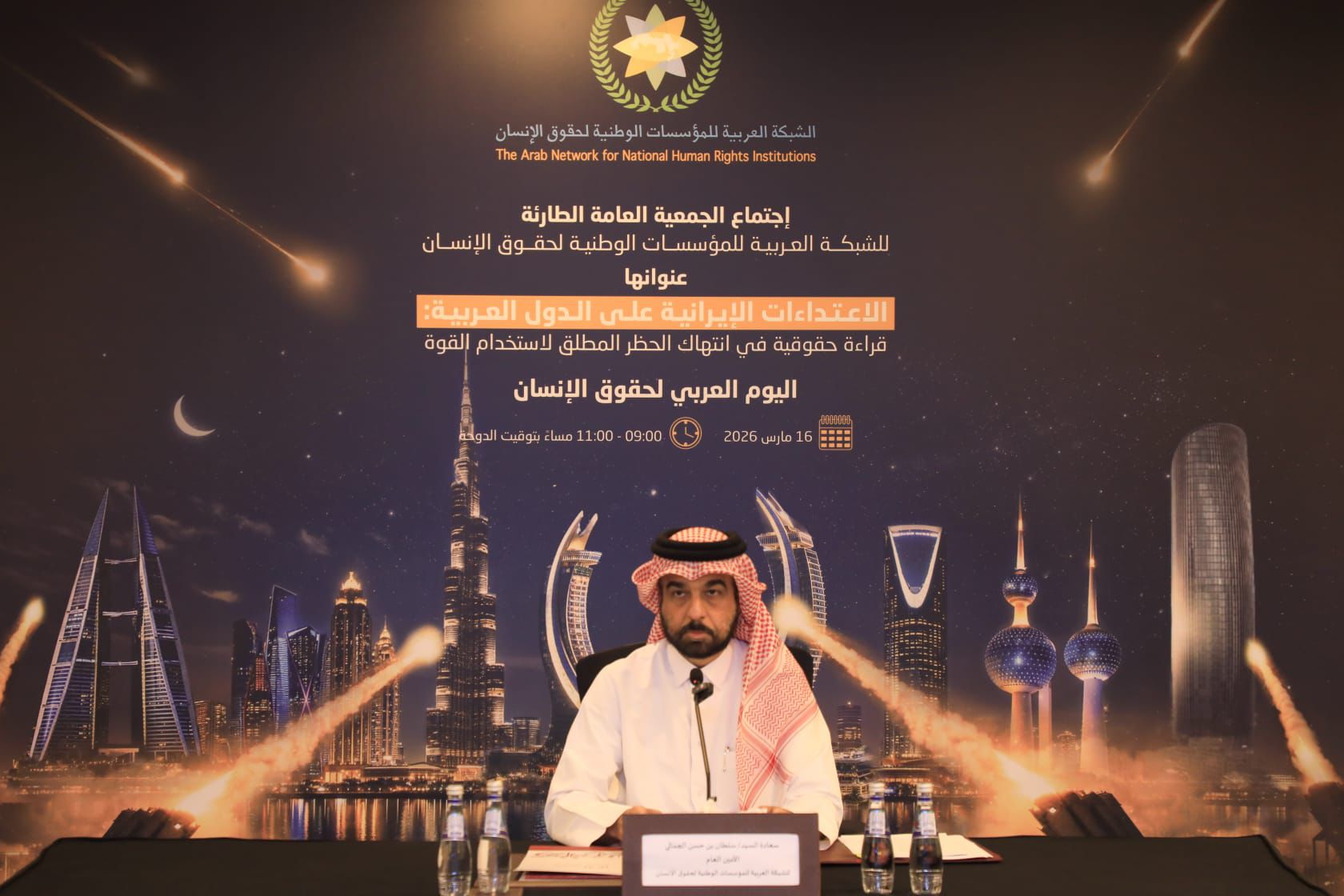
Doha: At the invitation of Qatar’s National Human Rights Committee (NHRC), the Arab Network for National Human Rights Institutions (ANNHRI) convened an extraordinary General Assembly meeting online from its headquarters in Doha to discuss recent Iranian attacks on several Arab countries and assess their implications from a human rights perspective.
The meeting, titled “Iranian Attacks on Arab States: A Human Rights Perspective on the Violation of the Absolute Prohibition on the Use of Force,” brought together representatives of national human rights institutions and experts from across the Arab region. Participants stressed that the attacks constitute a clear violation of the United Nations Charter and its binding principles, particularly the absolute prohibition on the use of force, warning that such actions threaten international peace and security and endanger civilians.
Participants issued a number of recommendations aimed at strengthening civilian protection during conflicts. These included enhancing mechanisms to monitor and document military attacks and their impact on civilians, preparing periodic reports for relevant international bodies, and developing rapid response protocols for cross-border attacks. They also called for the formation of human rights emergency teams and stronger cooperation among Arab national institutions to exchange information and expertise on protecting civilians during crises.
The meeting also emphasized the need to unify the Arab human rights position regarding attacks targeting civilians and to activate human rights diplomacy through engagement with the United Nations and other international organizations to ensure accountability. Participants urged the United Nations to launch an independent investigation into the attacks affecting Arab states and called on the UN Human Rights Council to convene a special session dedicated to protecting civilians in the Arab region.
Participants further stressed the urgent need to halt military escalation and return to diplomatic solutions to safeguard civilians and maintain regional stability, while activating international accountability mechanisms to prevent impunity.
Engineer Ali Ahmed Al-Derazi, Chairman of the Arab Network for National Human Rights Institutions and President of Bahrain’s National Institution for Human Rights, said the network had been following the recent military escalation in the region with deep concern. He noted that missile attacks targeted several Arab countries, including Bahrain, Saudi Arabia, the United Arab Emirates, Qatar, Kuwait, Oman, Jordan and Iraq, resulting in damage to residential areas and causing civilian casualties and injuries from missile fragments.
Al-Derazi stressed that such attacks pose a direct threat to civilian security and social stability and represent a clear violation of international humanitarian law, which prohibits targeting civilians and civilian infrastructure. He also praised diplomatic efforts undertaken by Arab states, including an initiative presented by Bahrain at the United Nations Security Council on behalf of Gulf countries and Jordan, calling for condemnation of the attacks, their immediate cessation, and respect for the sovereignty and territorial integrity of states.
He reaffirmed the Arab network’s solidarity with the affected countries and highlighted the importance of unified Arab positions to confront threats to the safety of people and territories while ensuring respect for international law and human rights standards.
Dr. Mohammed bin Saif Al-Kuwari, Vice-Chairman of Qatar’s National Human Rights Committee, said the emergency meeting comes at a time of exceptional regional circumstances that require strong coordination among human rights institutions. He described the attacks as a serious violation of international law and a direct threat to regional stability.
Al-Kuwari revealed that the National Human Rights Committee in Qatar has established a crisis cell to receive complaints and reports and to monitor and document human rights violations related to the attacks. He also praised the swift response of national authorities in activating early warning systems and emergency plans, which helped protect lives and maintain essential services.
He warned that continued cross-border attacks could undermine the enjoyment of human rights not only in the region but also globally, noting that the escalation could affect energy supplies, international air and maritime navigation, and global food security.
In a working paper presented during the meeting, Sultan bin Hassan Al-Jammali, Secretary-General of the Arab Network for National Human Rights Institutions, stressed the need to strengthen regional coordination among national human rights institutions. He proposed establishing a permanent Arab mechanism for coordinating responses to human rights crises, including a specialized crisis coordination team under the network’s secretariat.
The proposed team would include contact points from each national institution responsible for collecting and analyzing information, unifying human rights messaging, preparing joint positions and coordinating international advocacy efforts. Al-Jammali also suggested creating a secure electronic platform to exchange field reports and urgent updates on violations and organizing training programs on monitoring violations during armed conflicts in cooperation with relevant United Nations bodies.
Dr. Abeer Al-Kharisha, Director of the United Nations Training and Documentation Centre for Human Rights for Southwest Asia and the Arab Region, warned that the escalation in the region has significant economic and environmental repercussions worldwide. She noted that large-scale attacks on residential areas have spread fear among civilians and disrupted essential services.
According to Al-Kharisha, civilian infrastructure such as health facilities, educational institutions, cultural property, water networks, desalination plants and energy installations in affected Arab states have been damaged, increasing the humanitarian burden on local populations.
Nasser Marzouq Al-Marri, Director of Legal Affairs at Qatar’s National Human Rights Committee, said that Gulf Cooperation Council countries, including Qatar, were not parties to the conflict but had instead played a mediating role aimed at reducing tensions and promoting dialogue and negotiations.
He noted that the attacks contradict established principles of international law, particularly the principle of good faith and the norms governing good neighborly relations between states.
Participants concluded the meeting by reaffirming that protecting human dignity and safeguarding civilian lives must remain at the center of any regional or international response. They stressed that sustainable security in the region can only be achieved through respect for state sovereignty, strengthened cooperation among nations, and the promotion of peace and stability.

At 'Your World in Words,' we share stories from all over the world to make friends, spread good news, and help everyone understand each other better.
© 2026
Rahbar International
Leave a Reply