
rki.news
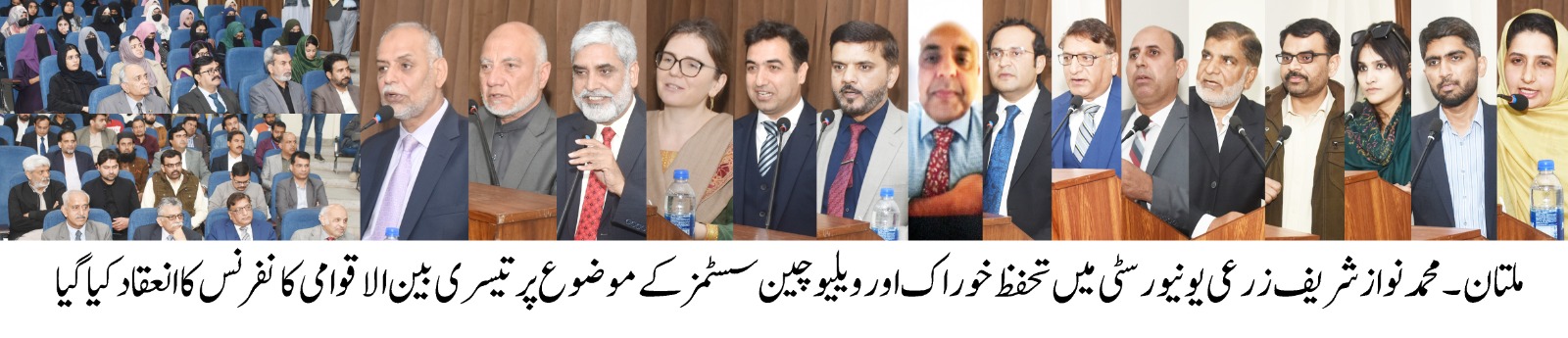
Multan, February 11, 2026 – Muhammad Nawaz Shareef University of Agriculture, Multan, hosted the Third International Conference on Food Security and Value Chain Systems, attracting a distinguished assembly of national and international experts, faculty members, researchers, students, policymakers, and representatives from development organizations. The conference commenced with the recitation of the Holy Quran.
Vice Chancellor Prof. Dr. Asif Ali welcomed the participants, underlining that climate change, water scarcity, declining soil fertility, and rapid population growth have made the establishment of sustainable agricultural systems and robust value chains an urgent necessity. He emphasized that Pakistan’s food security can be strengthened through modern research, digital technologies, artificial intelligence, and enhanced institutional collaboration.
Prof. Dr. Irfan Ahmad Baig, Dean of the Faculty of Social Sciences and Humanities, presented an overview of the conference, highlighting its aim to provide a platform for experts to propose practical solutions and policy recommendations for sustainable agriculture, economic empowerment of farmers, resilient food systems, and improved value chains.
During the inaugural session, international experts delivered keynote speeches. Dr. Shujahat Khan from New Zealand discussed AI, digital platforms, and global collaboration in transforming agriculture. Prof. Dr. Amos Mensah (Ghana) outlined strategies to strengthen value chains, improve market access, and enhance smallholder farmer livelihoods. Dr. Sarah Holz (Germany) stressed inclusive development and social transformation approaches to address complex challenges within food systems. Dr. Tariq Rana (Australia) highlighted the water–food nexus and the importance of efficient resource management and climate-resilient agricultural planning in Pakistan.
A question-and-answer session facilitated interactive discussion between participants and speakers. Concluding remarks were given by Ms. Imelda Brigina, Senior Technical Advisor, Government of Punjab, who praised the conference as timely and underscored linking research outcomes with policymaking and practical implementation.
The technical program includes sessions on food security, agricultural economics, climate change adaptation, sustainable agriculture, biodiversity, value chain development, digital and smart agriculture, agribusiness, market systems, and community empowerment. Researchers presented findings on wheat production risks, modern irrigation strategies, soil health, nitrogen emission reduction, AI and machine learning applications, farmer capacity building, women’s economic inclusion, and climate adaptation strategies. International participants joined online, enhancing collaborative learning and knowledge exchange.
The conference will continue for two more days. Chairman of Pakistan Science Foundation, Prof. Dr. Akmal, and Dr. Sarah Holz were also present at the inaugural session, contributing to discussions on food security and agricultural development in Pakistan.

At 'Your World in Words,' we share stories from all over the world to make friends, spread good news, and help everyone understand each other better.
© 2026
Rahbar International
Leave a Reply