
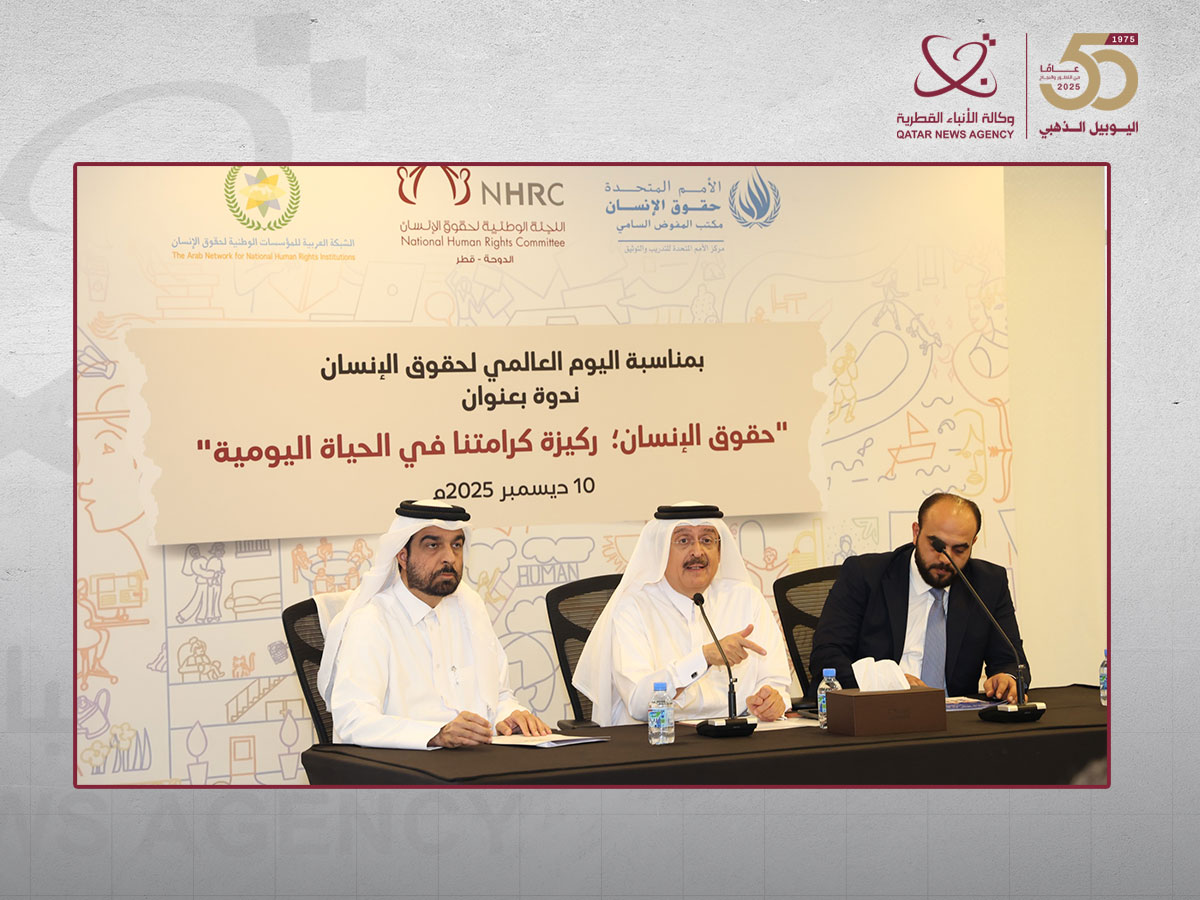
Doha, December 9 (QNA) — The National Human Rights Committee (NHRC), in partnership with the General Secretariat of the Arab Network of National Human Rights Institutions and the United Nations Center for Training and Documentation in Human Rights for South-West Asia and the Arab Region, organized a special talk to mark Human Rights Day. The event aimed to reaffirm that human rights are not mere slogans or legal texts but the foundation of daily interaction, and a shared responsibility requiring cooperation between governments, civil society, and global institutions.
Opening the session, HE Dr. Mohammed bin Saif Al Kuwari, Vice-Chairman of the NHRC, said that Human Rights Day marks a defining milestone in modern history. He noted that global awareness of human dignity and equality has significantly advanced since the adoption of the Universal Declaration of Human Rights, to which Arab thinkers and diplomats made notable contributions. He reminded the audience that only decades ago, entire populations were considered inferior, and discrimination was widely accepted.
Dr. Al Kuwari added that the world today faces increasingly complex challenges—ranging from climate change and environmental degradation to terrorism, digital transformation, and armed conflicts—all of which contribute to serious human rights violations. Addressing these issues, he said, demands coordinated international action that ensures scientific progress and development benefit all of humanity without discrimination.
He emphasized that in Qatar, the occasion carries special importance, reflecting the country’s consistent commitment to upholding human dignity. Qatar’s Permanent Constitution reinforces these principles, in harmony with Islamic Sharia, the main source of national legislation. He highlighted the State’s dedication to implementing the human rights conventions to which it is a party.
The NHRC, he noted, plays a central role in promoting rights culture, drawing on an Islamic civilizational heritage founded on justice, equality, and noble values. The Committee continues to work across key areas, including education, health, labor, environmental protection, and the rights of vulnerable groups such as children, women, older persons, and persons with disabilities. He also recalled the NHRC’s role in ensuring that no individual was deprived of their rights during major events hosted by Qatar, including the COVID-19 pandemic and international sporting tournaments.
HE Sultan bin Hassan Al-Jamali, Secretary-General of the Arab Network of National Human Rights Institutions, said the High Commissioner’s theme for this year is a call to rediscover the essence of human rights within daily life. National institutions, he said, play a crucial role in converting international commitments into reality, acting as a vital link between governments and civil society.
He noted that these institutions help embed a culture of rights, strengthen compliance, and encourage change from within through awareness and constructive engagement with global mechanisms. Empowering national institutions, he added, ensures that dignity and justice become part of everyday experience.
Al-Jamali stressed that knowledge of rights enables individuals to claim them and helps societies and states integrate them into policies. Development without a rights-based foundation, he warned, leads to fragile progress and deeper marginalization. He highlighted the monitoring role of national institutions in following up on the Sustainable Development Goals and ensuring their alignment with human rights commitments.
He drew attention to the Network’s efforts to link development indicators with a human-rights approach centered on people, enabling fairer policies and more comprehensive reporting. He said the tragic situation in the Gaza Strip starkly exposes systematic violations of fundamental rights, including life, safety, and dignity, reminding the world that celebrating Human Rights Day is meaningless while such suffering continues. He urged stronger global action, documentation of violations, and support for international courts to ensure accountability.
Representing the UN Training and Documentation Center, Hindam Al Rajoub said Human Rights Day is a renewed call to uphold the values of dignity, freedom, equality, and justice. He stressed that human rights are not abstract concepts, but essential foundations guiding daily life. Bridging the gap between universal principles and lived realities, he noted, remains the real challenge.
He said global crises—from conflict and discrimination to poverty and climate change—underscore the need for greater solidarity. Inclusive policies, he added, can transform lives and build social cohesion. He concluded that upholding human rights is essential to building a just and peaceful future, and ensuring that these rights become a tangible reality for every individual, without exclusion or discrimination.

At 'Your World in Words,' we share stories from all over the world to make friends, spread good news, and help everyone understand each other better.
© 2026
Rahbar International
Leave a Reply