
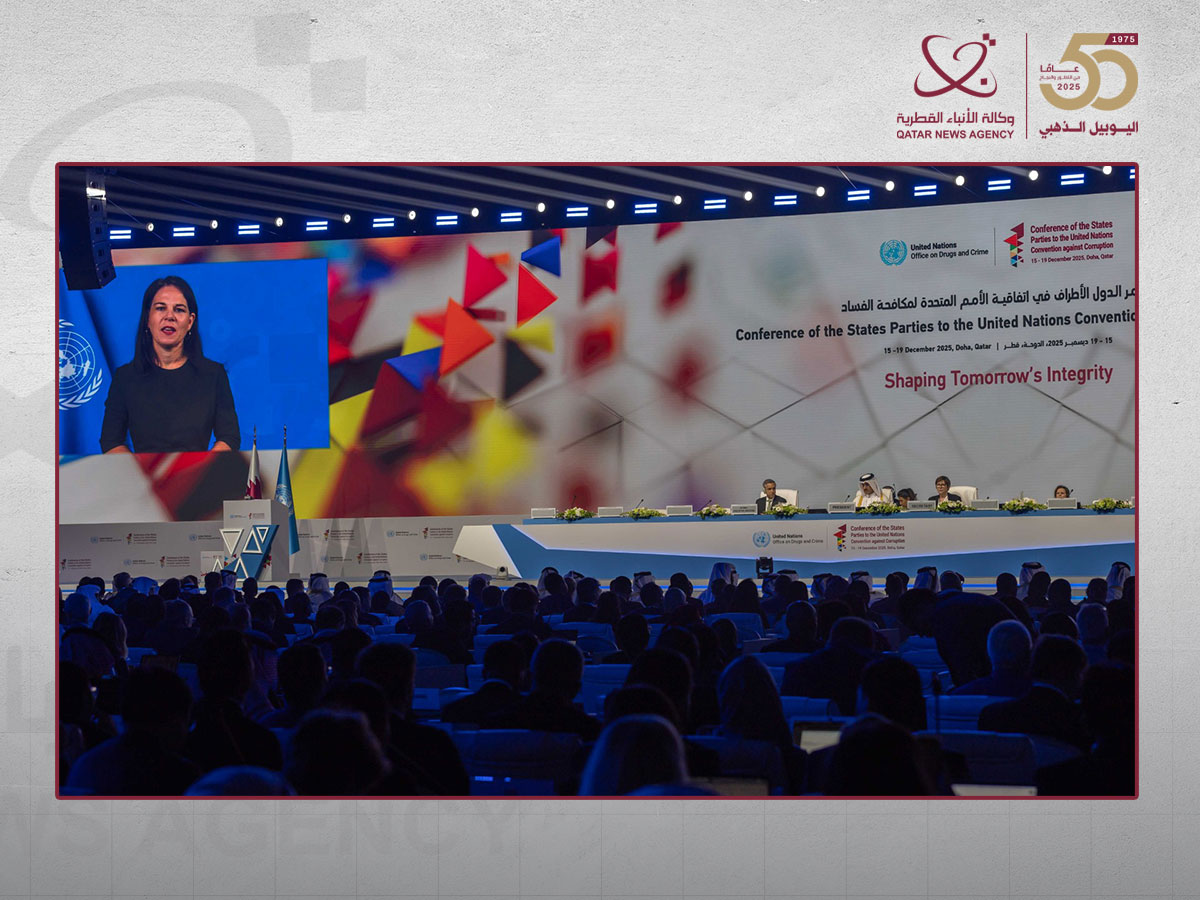
Doha, December 15 (QNA) – HE President of the 80th session of the United Nations General Assembly, Annalena Baerbock, stressed the shared responsibility of the international community and all parties to prevent and eradicate corruption and to combat crime, which leaves victims everywhere.
In a recorded video address at the opening session of the Conference of the States Parties to the United Nations Convention against Corruption (UNCAC), currently taking place in Doha, Her Excellency said that corruption is not a victimless or abstract crime, but one that has real and tangible consequences for people.
She pointed out that when building regulations are circumvented through corrupt practices, unsafe structures are erected and may collapse, resulting in loss of life. When bribery spreads unchecked within companies, wealth is siphoned off for the benefit of a privileged few, while economies grow in an uneven and unstable manner and suffer from a lack of public trust. And when corruption permeates the legal system, cases are mismanaged, justice is delayed or denied, and victims are silenced.
Her Excellency affirmed that preventing and eradicating corruption is ultimately a shared duty, and that all are accountable to the people whom relevant organizations and institutions are meant to serve.
She also pointed to international efforts to combat corruption, noting that States Parties to the United Nations Convention against Corruption have committed to strengthening and advancing anti-corruption measures. World leaders also agreed to enhance international cooperation at the 2021 Special Session of the General Assembly against corruption. She added that the Pact for the Future underscored the necessity of combating corruption to reduce inequalities and close development gaps, while the Declaration on Future Generations reaffirmed that the systems and institutions we leave behind must reflect our highest values, not narrow interests.
Her Excellency called for updating and adapting existing approaches, particularly as modern techniques of financial corruption have enabled seamless cross-border operations and allowed criminal networks to evade accountability.
In this context, she stressed the need for regulatory frameworks and technological safeguards to be equally flexible and capable of combating and dismantling such crimes.
She noted that the 11th session of the Conference of the States Parties to the United Nations Convention against Corruption represents an opportunity to achieve this by building on shared commitments to prevent corruption, strengthening public trust, and reinforcing institutions and governance.
She said the conference theme, “Shaping Tomorrow’s Integrity,” serves as a call to action to turn promises into concrete steps, enhance oversight, protect whistleblowers, and harness technology to promote transparency rather than exploitation.

At 'Your World in Words,' we share stories from all over the world to make friends, spread good news, and help everyone understand each other better.
© 2026
Rahbar International
Leave a Reply