


rki.news
Interview by Haroon Rashid Qureshi, Editor in Chief, Rahbar Kisan International
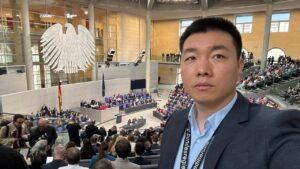
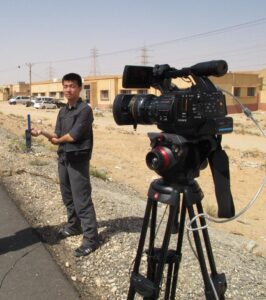
Yu Peng is a journalist with China Central Television (CCTV) who has worked in television journalism for about 16 years. Currently based in Dubai, he covers the Middle East with particular attention to Qatar and the wider Gulf region. During his professional career, he has reported from several countries and witnessed major changes in the media industry, including the rapid growth of social media and the arrival of artificial intelligence.
During his recent visit to Qatar, Yu Peng spoke with Rahbar Kisan International about his professional journey, his early experience in the Middle East, changes in journalism and the growing influence of social media platforms such as TikTok. He also discussed international media cooperation and shared his thoughts on the future of journalism and the responsibilities of young journalists.
Yu Peng said he has been working for China Central Television for around 16 years. He is currently based in Dubai and covers the Middle East. He also covers Qatar and has been focusing particularly on the country since April or May this year. His work requires him to travel around the region to cover important developments and events.
He graduated in 2010 with a major in Arabic language and literature. This background played an important role in determining his first professional assignment. His first station was in Lebanon, where he stayed for two years.
His early experience in the region coincided with the Arab Spring and a period of major political and social upheaval across the region. During his time in Lebanon, he travelled to several countries affected by conflict, including Syria, Libya and Somalia.
Explaining how he became interested in journalism, he recalled his student days at Damascus University. Around 2008, he was studying there when he followed television coverage of the Israeli-Palestinian conflict.
He particularly remembered watching reports from Al Jazeera. Television coverage included news from the ground as well as debates involving different sides. These reports helped him understand what was happening and gradually inspired him to become a journalist.
At that time, television and traditional media had a particularly strong influence in China. People watched television reports closely, and he saw the impact of media coverage. He felt journalism offered a unique opportunity to understand different places and situations.
He described being a journalist as a kind of privilege because journalists have the opportunity to know what is happening in different places. This opportunity to meet people, travel and learn about events directly became an important part of his professional interest.
Looking back at his career, he said his professional experience has been mainly in television. CCTV has remained the main platform of his career. He also worked as an intern at People’s Daily for three months, but most of his professional career has been in television.
He has witnessed major changes in the media industry during his career. When he started working in journalism, television was the most powerful medium. In recent years, social media has taken a much stronger position.
People now receive a large amount of information through social media platforms. Journalists also use social media to gather information and follow developing stories.
At the same time, he stressed the importance of distinguishing between information available on social media and confirmed news. Social media can provide information and clues, but it does not always mean that the information has been verified.
He explained that established television media normally goes through a process of confirmation before reporting a story. This gives traditional media an important role in verifying information.
However, he does not see social media only as a challenge. He considers it a useful way to follow public opinion and find clues about developing stories. For journalists, social media can therefore be an important source when used carefully and responsibly.
Discussing TikTok and other social media platforms, he said they have definitely changed professional journalism. Television reporters traditionally conduct interviews, prepare reports and present serious news through established broadcasting formats.
Social media has introduced a different style. Journalists and media organisations can communicate in a more energetic way. The presentation can be less formal while the subject itself can remain serious.
Another major difference is speed. Traditional television news normally goes through a preparation process before being sent to the channel for broadcast. On TikTok and similar platforms, information can be shared directly from the location.
Yu Peng also pointed to another important issue. People can sometimes be attracted to strong or polarised opinions. He observed that TikTok creators and YouTubers who express stronger opinions can sometimes gain more followers and develop a bigger voice than traditional mass media such as television.
International cooperation is another area he considers important for the future of media. He said cooperation between media organisations in different countries can make it easier to verify information and carry out fact-checking.
He gave the example of covering events in Qatar. As a journalist from China working in the region, he can find it easier to verify information about Qatar through local media organisations such as Qatar TV or Qatar News Agency.
Such cooperation can help journalists understand local developments and produce more reliable reports. It can also allow media organisations to exchange information and professional experience.
He noted that every country has a different media environment and media institutions have their own approaches. International cooperation provides an opportunity for organisations to learn from each other and adapt to changes in the media industry.
On stronger media cooperation between China and other countries, he described cooperation as a form of exchange. He explained that media cooperation is not only about news content. Technology and professional experience are also important parts of modern media cooperation.
He pointed to the work being carried out through CCTV and China Media Group. According to him, more agreements and cooperation arrangements are being developed with international media organisations.
Looking toward the future of journalism, he focused particularly on social media and artificial intelligence. He said young journalists need to prepare themselves for this changing environment.
In his view, reading and analysis remain essential skills for journalists. Young journalists should not totally depend on information provided by artificial intelligence. Technology can provide information and assistance, but journalists still need to read carefully and analyse information.
He also encouraged young journalists to travel and visit different places. Meeting people and talking to them directly is an important part of journalism. For him, real experience comes from being present in different environments and listening to people.
For Yu Peng, journalism continues to offer an opportunity to understand people and events from different perspectives. His journey from studying Arabic language and literature to working across the Middle East and covering Qatar reflects the changing nature of international journalism.
His experience also highlights how television journalism has evolved during the past 16 years while social media has become an increasingly important part of the news environment. At the same time, his emphasis on verification, international cooperation, reading, analysis and direct contact with people reflects the continuing importance of professional journalism in a rapidly changing media landscape.
Yu Peng Discusses Media Changes, Social Media and Global Cooperation