

rki.news
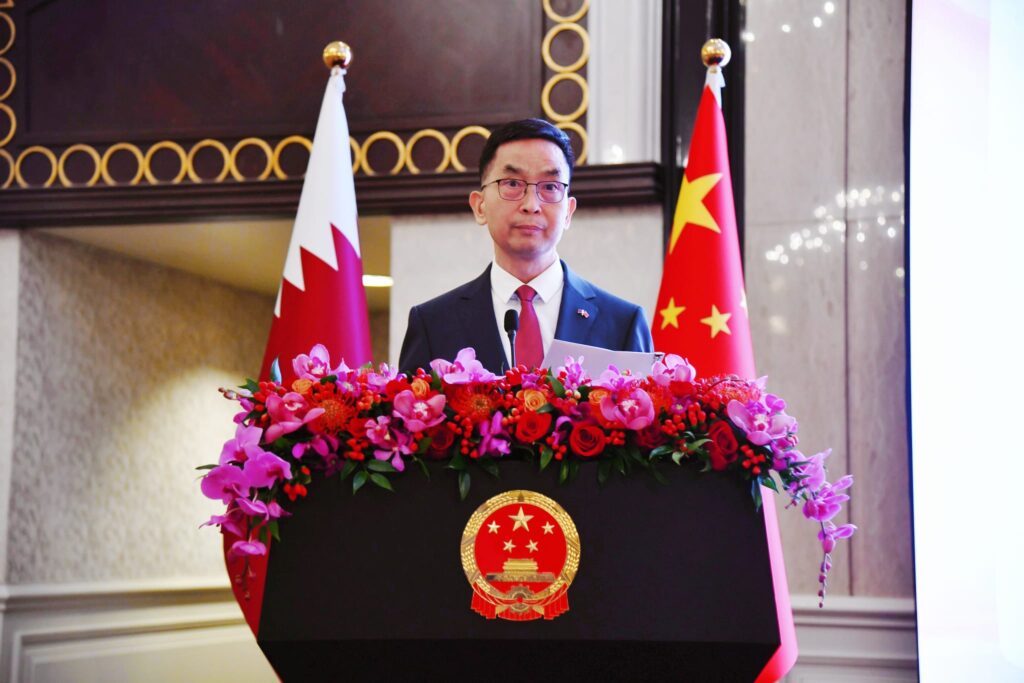
DOHA, October 1, 2026: The Chinese Embassy in Qatar hosted a reception in Doha on September 30 to celebrate the 77th Anniversary of the Founding of the People’s Republic of China.
The reception was attended by *H.E. Sheikh Mohammed bin Abdulla bin Mohammed Al Thani, Minister of Transport; H.E. Ibrahim Yousif Abdullah Fakhro, Director of the Department of Protocol at the Ministry of Foreign Affairs; and H.E. Ali Ibrahim Ahmed, Ambassador of Eritrea and Dean of the Diplomatic Corps in Qatar*.
The gathering also brought together heads of diplomatic missions, defence attachés, Ministry of Foreign Affairs officials, business representatives, members of the Chinese community and other distinguished guests.
Welcoming the guests, *H.E. Ambassador Cao Xiaolin* expressed his greetings and appreciation to friends from all sectors who have supported China’s development and friendship between China and Qatar.
In his remarks, Ambassador Cao highlighted China’s transformation over the past 77 years, saying the country had developed from poverty and a weak industrial base into the world’s second-largest economy.
He said China had achieved rapid economic development and long-term social stability while contributing to global economic growth. Over the past five years, China’s economy grew at an average annual rate of 5.4 percent, while its contribution to global economic growth remained around 30 percent.
China’s economic output reached 140 trillion yuan in 2025, while the economy grew 4.7 percent in the first half of 2026, demonstrating economic resilience.
He noted that China is a major trading partner of more than 160 countries and regions and supports global industrial and supply chains.
Ambassador Cao also highlighted China’s progress in science and technology, including humanoid robots, semiconductors, space technology and artificial intelligence. He noted the establishment of the World Artificial Intelligence Cooperation Organization in July as an important development in international cooperation on AI governance and applications.
He described Chinese modernization as involving a huge population, common prosperity, cultural advancement, harmony between humanity and nature and peaceful development.
He highlighted the Belt and Road Initiative, saying cooperation has expanded since 2013 to more than 150 countries and over 30 international organizations, with more than 4,000 cooperation projects and investment exceeding US$1 trillion. He said Belt and Road cooperation has become an important platform for an open global economy and shared benefits.
Ambassador Cao outlined China’s four global initiatives covering development, security, civilization and governance. He said they aim to promote development, strengthen security, encourage dialogue among civilizations and advance fairer global governance.
Turning to the Middle East and Gulf region, Ambassador Cao said the conflict since the end of February had caused serious consequences for regional countries and disrupted global economic development.
He said China had consistently called for a ceasefire and an end to hostilities, opposed unilateral military action and maintained communication with relevant parties to promote reconciliation, dialogue and de-escalation.
The Ambassador referred to President Xi Jinping’s state visit to the United States and discussions with President Donald Trump on international and regional issues, including the Middle East and Gulf region. He highlighted President Xi’s four-point proposal for a new Middle East security architecture, focusing on common security, development and stronger international coordination.
On China-Qatar relations, Ambassador Cao stressed the importance of the strategic partnership between the two countries. He noted that President Xi Jinping and *His Highness the Amir Sheikh Tamim bin Hamad Al Thani* had maintained frequent exchanges of letters this year, providing strategic guidance for bilateral relations.
He also highlighted the recent visit to China by *H.E. Sheikh Mohammed bin Abdulrahman bin Jassim Al Thani, Prime Minister and Minister of Foreign Affairs of Qatar*. During the visit, Chinese Premier Li Qiang and Foreign Minister Wang Yi discussed new plans for China-Qatar cooperation.
Ambassador Cao said China stands ready to work with Qatar to implement the common understandings reached by the leaders of both countries and advance an even more brilliant “golden decade” for the China-Qatar strategic partnership.
He identified four areas for cooperation: strategic mutual trust, practical cooperation, people-to-people exchanges and multilateralism.
China, he said, will continue supporting Qatar’s sovereignty, independence, security and stability while appreciating Qatar’s adherence to the one-China principle.
On practical cooperation, Ambassador Cao highlighted opportunities in investment, traditional and new energy, infrastructure, artificial intelligence and finance. He said China is ready to strengthen energy cooperation and explore railway development and regional connectivity.
He stressed the importance of cultural, educational and tourism exchanges, as well as giant panda conservation and research, in strengthening friendship between the Chinese and Qatari peoples.
Concluding his remarks, he praised Qatar’s diplomatic efforts to mediate hotspot issues and its contributions to resolving disputes and promoting peace.
Ambassador Cao called for continued coordination between China and Qatar to advance their strategic partnership, implement the four global initiatives and contribute to peace, development and stability in the region and globally.
Quoting a Chinese saying that “actions speak louder than words” and an Arabic proverb that deeds are the fruits while words are the leaves, Ambassador Cao called for joint efforts to take China-Qatar relations to a new level and make new contributions to global peace and development.