
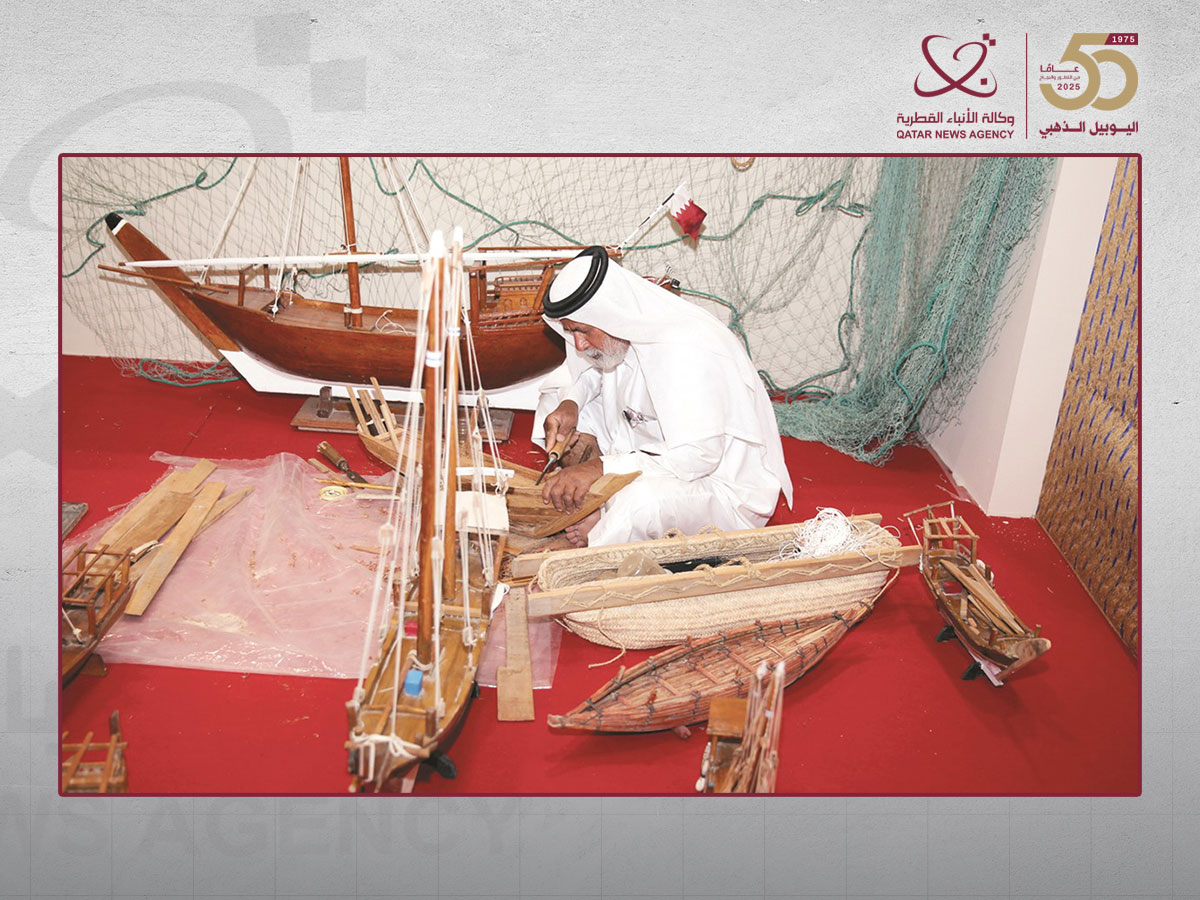
Doha, December 17 (QNA) — Traditional shipbuilding has been a cornerstone of economic and social life in Qatar and across the Gulf Cooperation Council (GCC) countries, deeply connected to the sea as a source of livelihood, transportation, and cultural exchange. Wooden dhows historically represented more than a means of transport; they embodied a complete way of life, reflected in heritage and popular memory that remains alive today.
The Katara Traditional Dhow Festival, now in its 14th edition, is a key annual event supported by state institutions to preserve this craft. It highlights maritime heritage, including traditional shipbuilding, and works to pass these skills on to future generations.
In statements to Qatar News Agency (QNA), heritage researcher Abdulaziz Al Buhaishim Al Sayed explained that maritime heritage represents a significant part of Qatar’s history. Most old Qatari villages were coastal, with livelihoods dependent on pearl diving, fishing, and maritime trade. He noted that Qatar’s maritime trade connected it with regions such as India, and pearl diving expeditions could last up to four months, making the sea an integral part of daily life. Al Sayed emphasized that pearl diving in the region has a documented history of over two thousand years, with references from Greek historians noting the quality of pearls and the region’s renown.
Al Sayed added that maritime voyages facilitated cultural exchange, connecting Gulf communities with other civilizations, and that Qatar’s location made it a hub for divers across the Arabian Gulf. At certain times, Qatar had approximately 800 pearl diving vessels, each carrying 25 to 30 people. He praised the Katara Traditional Dhow Festival as a living memory of Qatar’s historical relationship with the sea and as an opportunity to learn about maritime vocabulary, songs, customs, and traditions.
Eng. Ahmed Jassim Al Sayegh, specialist in traditional wooden dhow modeling, explained that wooden dhows were once a key economic pillar in Qatar and the GCC, transporting essential goods like spices, timber, iron, textiles, and other materials. Dhows also provided transportation between cities such as Doha, Al Wakrah, and Al Khor.
Addressing modern challenges, Al Sayegh highlighted high construction and maintenance costs, competition from fiberglass boats, scarcity of skilled craftsmen, and difficulties in sourcing suitable timber. Wooden vessels require constant care, including regular maintenance, water pumping, and periodic painting to prevent damage.
Government support has been crucial in preserving this heritage, providing assistance to vessel owners, inclusion in cultural events, and workshops. Completed heritage vessels are handed over to museums or the Ministry of Culture as part of national documentation efforts. Al Sayegh emphasized the importance of documenting traditional shipbuilding as a precise engineering discipline and called for museums and educational workshops to ensure knowledge transfer to future generations.
Al Buhaishim and Al Sayegh stressed that festivals like Katara’s are essential for GCC countries, reflecting a shared maritime heritage, cultural memory, and civilizational legacy that continue to connect communities to the sea.

At 'Your World in Words,' we share stories from all over the world to make friends, spread good news, and help everyone understand each other better.
© 2026
Rahbar International
Leave a Reply