rki.news
Being a healthcare leader today means more than treating the patient in front of you. It can also mean asking why a patient waited so long for care, why information did not follow them from one hospital to another or why a problem in one department created bigger problems somewhere else.
Those are the kinds of questions 29 healthcare leaders in Saudi Arabia spent five months examining through the inaugural Executive Leadership for Integrated Healthcare Management (ELIHM) program, delivered by Georgetown University in Qatar’s Executive and Professional Education department in partnership with Georgetown University School of Health and King Saud bin Abdulaziz University for Health Sciences (KSAU-HS).
Georgetown’s School of Health contributed to the curriculum and facilitated faculty appointments, bringing in senior leaders from MedStar Health, Georgetown’s academic health system partner, to share real-world lessons from healthcare practice. All modules were taught by MedStar Health senior executives.
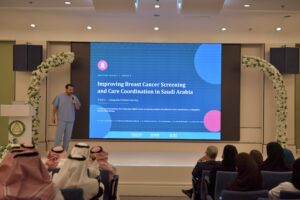
The question one team addressed was what happens between a woman’s first breast cancer screening in Saudi Arabia and her treatment.
The team started with the numbers. During their presentation, they pointed to data showing low breast cancer screening rates in Saudi Arabia and a younger age of diagnosis compared with Europe.
But as they looked more closely at the problem, they reached a different conclusion about where the biggest gap was.
“The problem is not with the patient. The problem is with the system,” one team member told the audience.
The system, they found, often waits for patients to initiate screening rather than reaching out to them. No one may clearly own the patient’s journey from screening to diagnosis and treatment. And when imaging or other diagnostic tests happen at one institution, that information may not follow the patient to the next.
By the time a patient reaches a tertiary care center, those gaps can mean more delays, repeated tests and more work to fill in what is missing. Patients with abnormal results would be assessed at a one-stop diagnostic clinic within two weeks, with a confirmed diagnosis and treatment plan within 60 days, in line with the World Health Organization’s Global Breast Cancer Initiative target.
The team proposed a more proactive approach. Women ages 40 to 69 would be actively called and recalled for screening.
The proposal would also give patients a designated navigator to help them move through the system. A digital safety net called “No Woman Lost” would flag patients at risk of falling out of the pathway before delays grow, and record whether each gap came from the patient, the referral process, the diagnostic service or a lack of capacity.
The idea was bigger than screening. It was about making sure someone, somewhere in the system, was responsible for what happened next.
That was one of five healthcare challenges tackled by the ELIHM cohort. The participants came from six Saudi organizations: KSAU-HS, Health Holding Company, Prince Sultan Military Medical City, Security Forces Hospital, King Faisal Specialist Hospital and Research Centre, and the Ministry of National Guard Health Affairs.
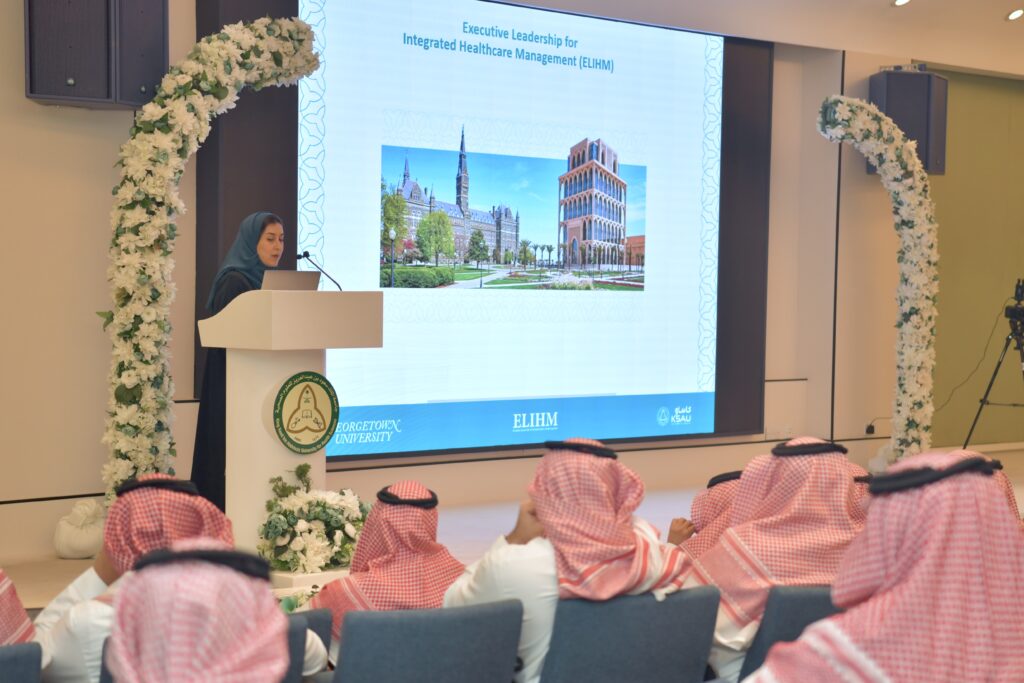
Over five months, participants worked through leadership and management modules before applying what they learned to challenges within their own healthcare systems. They presented their five capstone projects at the program’s completion ceremony on Sept. 28 at KSAU-HS.
The other teams tackled challenges including chronic disease management and coordination between primary care and hospitals.
“As referenced by the first group, nine times out of 10, it is not the patient who is at fault. Instead, something about the system is broken,” said Christopher J. King, Ph.D., dean of Georgetown University’s School of Health. “Improvement requires us to interrogate the status quo with an interdisciplinary lens so patients get the right care, at the right time, and by the right provider.”
For Munirah Alkhuwaiter, Ph.D., ELIHM program director, that shift in perspective is at the heart of the program.
“ELIHM creates a focused space for healthcare leaders to strengthen their leadership practice, exchange perspectives, and learn across institutional boundaries,” Alkhuwaiter said. “Its real impact begins when learning extends beyond the individual, shaping how institutions work together and how the healthcare ecosystem moves forward.”
Andrew Henley, chief operating officer and senior strategy adviser at Georgetown University in Qatar, said systems thinking matters because decisions made inside a hospital can have consequences far beyond a single department.
“The results matter to people who have no reason to know how the system is organized,” Henley said. “For them, integration can mean arriving at a specialist’s office without having to explain everything again, or spending less of the afternoon waiting for care.”
That is what the capstone projects were designed to address: the gaps patients experience when different parts of a healthcare system do not work together.
The teams’ recommendations will be considered for further development following the final presentations.
Georgetown and KSAU-HS have also begun early conversations about a future ELIHM cohort, as well as a separate leadership program for nurses.