

rki.news
Gathering runs until 20 September under the theme ‘With Our Ideas, We Build’
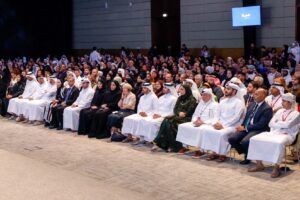
Doha, Qatar – 19 September 2026: The second edition of the BilAraby Annual Gathering 2026, organized by Qatar Foundation’s BilAraby initiative under the theme ‘With Our Ideas, We Build’, has begun today at Multaqa (Education City Student Center) in Doha. The gathering brings together senior dignitaries, alongside thinkers, creators, and experts from various sectors, to discuss ways of harnessing knowledge and creativity to address issues facing society.
The gathering features 14 speakers on its main stage. Through dialogue that brings together diverse experiences and allows issues to be examined from different perspectives, participants are exploring ways to leverage knowledge and innovation to develop solutions that respond to the needs of communities while taking their cultural contexts into account. The program addresses media, science and technology, Artificial Intelligence, precision medicine, and genomics, alongside architecture, heritage, entrepreneurship, and environmental sustainability. It also covers peacebuilding, sports, and social work.
Abdulrahman Ibrahim Al-Ajail, Executive Director, Office of the Chief Executive Officer, Qatar Foundation, said: “At BilAraby, we bring together people with knowledge and experience so that they can learn from one another and find in the diversity of their experiences what can help them understand the issues that matter to their communities.
“Many of life’s challenges cannot be addressed by a single discipline; what may appear clear in theory may need to be reconsidered when tested in practice. We want Arabic to be the language of this exploration, and we want Arabic speakers to have a greater role in creating knowledge through their own creativity and what they learn from others. This is the meaning behind this year’s theme, ‘With Our Ideas, We Build’: ideas that emerge from understanding people and their circumstances, and return to them in ways that benefit them.”
The opening ceremony was hosted by prominent media presenters Mohamed Errammach and Sara Rasheed.
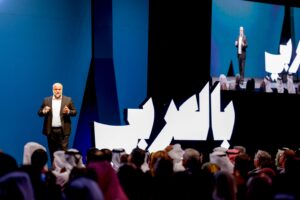
The ceremony began with a recitation of verses from the Holy Qur’an, followed by a short film about ideas, creativity, and their role in building the future, before journalist Wael Al Dahdouh, Head of the Gaza Strip Bureau, Al Jazeera Media Network, delivered the gathering’s first talk.
In his talk, ‘Please… Answer Me’, Al Dahdouh addressed the theme of resilience, recalling a message from his wife while he was covering the war and the conflict he faced between his duty to report people’s suffering and his fears for his family. Describing the experience of a journalist reporting from within his own community, he said: “He talks about everything except the war raging within him.”
Al Dahdouh recounted how he returned to journalism after losing his wife and several members of his family. Addressing his children, he said: “You have been, and remain, one of the secrets of my resilience, survival, and ability to keep going.” He identified four keys to remaining steadfast: love, faith, preparedness, and acceptance, stressing that “reporting and defending the truth is an ethical and professional duty.”
Dr. Said Ismail, Professor of Genomics, Hamad Bin Khalifa University (HBKU), a member of Qatar Foundation (QF), discussed the role of genomics in understanding identity and tracing historical connections among the peoples of the region. Drawing on examples from DNA studies in Egypt and Yemen, he explained how genetic overlap reveals a long history of migration and contact between communities. He stressed that DNA is neither a passport nor a title deed to land.
“I can read history through DNA,” Dr. Ismail said. “This complex code does not just determine our physical traits and health characteristics; it is also a highly accurate historical record.”
Alongside the main-stage talks, the gathering featured exploratory sessions, workshops, and interactive spaces presented by local and regional partners. These activities give attendees the opportunity to discuss the topics raised, exchange experiences, and engage with ideas through hands-on participation and practice.
Among these activities was the ‘Arabic-Language Artificial Intelligence’ session presented by HBKU. Attendees discussed the challenges of making Arabic content available in machine-readable formats and learned about a search engine bringing together 150 dictionaries, as well as open language resources for Modern Standard Arabic and Arabic dialects. The session also showcased tools for identifying word meanings in context, while attendees asked about differences in vocabulary among dialects and ways to use these resources.
The program also featured ‘Gen Z and Beyond: Between Material Temptation and Questions of Values and Identity’, presented by QatarDebate Center, founded by QF. Khalid Al Ibrahim, Communications Officer, QatarDebate Center, said the session combined debate with expert dialogue, creating space for “questioning the concept of progress from both youth and academic perspectives, and thinking about the future we want for generations to come.”
In the interactive spaces, Qatar Scientific Club joined the Ministry of Sports and Youth in presenting 3D printing and robotics demonstrations. Mohammed Al-Qassabi, Head of the Robotics and Artificial Intelligence Department, Qatar Scientific Club, explained that these technologies help turn innovative ideas into tangible products. He said that bringing together thinkers and innovators from different fields at the gathering creates opportunities to develop ideas that help shape the future of the Arab world.
The BilAraby Annual Gathering 2026 continues until 20 September, with the second day’s main-stage talks beginning at 10am, including ‘What They Don’t Tell You About Billion-Dollar Companies’ by Hamad Mubarak Al Hajri and ‘Our Imagination Is Not a Luxury’ by Yasser Bahjatt. The day’s exploratory sessions include Al Sharq Forum’s ‘Initiative Accelerator Lab’, the Queen Rania Foundation for Education and Development’s ‘Read to Me’, and an introduction to the BilAraby Open Translation Project.
The gathering forms part of the year-round work of QF’s BilAraby initiative to create spaces for dialogue in Arabic and strengthen connections among people with ideas and expertise across fields of knowledge and creativity.
For more information about the BilAraby Annual Gathering 2026 and QF’s BilAraby initiative, please visit: www.bilaraby.qa.